Showing posts with label books on books. Show all posts

Sunday, December 6, 2009

Connections: Our Selves - Our Books


91. Connections: Our Selves - Our Books, by Leona Rostenberg and Madeleine B. Stern

Miss Rostenberg and Miss Stern were an amazing couple. They met in the early '30s, teaching Sabbath School, and became partners in life and in the rare book business. I wonder how many young women today have any conception how difficult their path was. Feminists, scholars, entrepreneurs, unmarried, in a world where women were expected to be none of those things, they lived, in the words of the New York Times obituary of Miss Rostenberg, "in a universe in which it was not possible to live the way she wanted to. She simply ignored that impossibility, created her own universe and, in a small but exquisite way, changed the world."

Between them, they wrote or edited upwards of thirty books, and innumerable sale catalogues. This book is rather special, though. Here, they describe books that they have bought and sold over the years, but these are all books with special meaning for one or the other or both. For Leona, who had been told by a college professor not to set her sights too high because she was "a woman and a Jew", and who was distantly related to Alfred Dreyfus, finding Émile Zola's pamphlet, "L'Affaire Dreyfus. Lettre A La Jeunesse", was a dramatic reminder of intolerance. Madeleine, who is, of course, best known for her work editing collections of Louisa May Alcott's potboilers, writes of the acquisition of the first edition of one of Alcott's earliest works, Flower Fables (stories she created for Ralph Waldo Emerson's daughter, Ellen).

There is the book that they never sold, the 1591 Parma imprint of Angeli Bonventura's La Historia della Citta di Parma, with a binding embossed with the arms of George Carew, Earl of Totnes, a book Leona had lusted for ever since she had apprenticed with the antiquarian bookseller, Herbert Reichner. And there is the book they never wrote, a proposed biography of Belle da Costa Greene. The proposal was rejected, as Anne Haight was in the process of writing a biography. In fact, that biography never appeared, though Haight did write a biographical entry on Greene for Notable American Women. (There is now a biography of Greene, Heidi Ardizzone's An Illuminated Life, which I have previously reviewed.)

What books have gone through their hands! What places they have scoured and found! What stories they have to tell! To find a copy of the first Hebrew edition of Theodore Herzl's Der Iudenstaat (the book that inspired the Zionist movement) is one thing. To find it on Erev Rosh Ha-shanah is quite another.

I could go on and on about these connections, the serendipitous finds, the books that escaped only to be found again, but you might as well read the book, enjoy the stories, and marvel at the full and fulfilled lives of Miss Rostenberg and Miss Stern.

Madeleine B. Stern (from the New York Times)
Leona Rostenberg (also from the New York Times)

Wednesday, July 29, 2009

Two Men Who Loved Books Too Much


55. The Man Who Loved Books Too Much: the True Story of a Thief, a Detective, and a World of Literary Obsession, by Allison Hoover Bartlett

There are many kinds of book collectors. Some collect a particular author or subject matter, some incunables and others modern first editions. Most are rational, law-abiding citizens. But sometimes the urge to collect becomes an obsession, as with Sir Thomas Phillipps' desire to own a copy of every book in the world. (I highly recommend A.N.L. Munby's Portrait of an Obsession, a distillation by Nicolas Barker of the five volumes of Phillipps Studies.) And sometimes, as with John Gilkey, the subject of Ms. Bartlett's book, it causes the collector to turn to crime.

Gilkey was (is?) a book thief. He seems to have wanted books, not for their content, but to have them, to possess them as physical objects, and as a signifier of taste. But, not having the money to build his collection, he took the view that he had a right to have a collection and that, if book sellers charged more than he could afford, he could simply take them. He gathered, often through retail jobs, credit card information, and used this to purchase books.

Bartlett juxtaposes Gilkey's story with that of Ken Sanders, a book seller and one-time chair of the Antiquarian Booksellers' Association of America security committee, who became as obsessed with hunting down Gilkey as Gilkey was with hunting down books to steal.

Bartlett conducted extensive interviews with both, and one of the most interesting aspects of this book is the way its writing caused the author to become a bit obsessed herself, not so much with books, though she feels a bit of temptation herself, but with the story. She goes with Gilkey, during a time when he was not locked up, to a store from which he had stolen in the past. He reveals to her certain information, and she struggles over whether to pass it on, knowing that, if she does so, he might close his mouth to her and affect her ability to write her book.

There are those who, looking at my double-shelved bookcases, and the piles of books on my floor and most flat surfaces in my apartment, would call me a woman who loves books too much. I feel what Bartlett terms the "sensory enticement" of books, enjoy the feel of a heavy paper with deckle edge, the smell of a leather binding, the heft of a volume in my hand. But I cannot fathom stealing a book, however tempted, and would say, with the medieval scribe, that a book thief should have "his name be erased from the book of the living and not be recorded among the Blessed".

The book is well-written and well-researched (though I noted a couple of errors in legal procedure, these are minor in relation to the book as a whole), and is sure to please all who love books, detective stories, and the psychology of obsession.


56. Bibliomania: a Tale, by Gustave Flaubert

This small volume from the Rodale Press contains the short story by Flaubert, based upon the true story of a monk who, upon the dispersal of his monastery's library, set himself up as a bookseller in Barcelona. When a rival book dealer outbid him for a unique volume, the rival's home burned down and the man's body was found in the ruins. When the book was found in Don Vincente's home, he was charged with the murder and confessed to it, and others - all people who had bought books from him, books that he could not bear to lose. At his trial for murder, his counsel argued against the alleged motive, contending that the book was not, in fact, unique. This revelation upset DonVincente more than being convicted and sentenced to death!

Flaubert's tale does not follow Don Vincente's story exactly. Some of the alterations he introduces create a very different sort of character of his protagonist. Giacomo, the former monk, was not a librarian. Indeed, he can barely read. His obsession is for books as objects: "He loved a book because it was a book; he loved its odour, its form, its title". His desire for the unique book is "to have it for himself, to be able to show to all Spain, with a smile of insult and pity for the King, for the princes, for the savants, for Baptisto, and say: 'Mine, this book is mine!' and to hold it in his two hands all his life, to fondle it as he touches it, to take in all its fragrance as he smells it!"

There is a twist at the end of Giacomo's trial that shows how far a man may go to ensure that he and he alone owns a book.

The Rodale Press edition has suitably spooky illustrations by Arthur Wragge (one accompanies this review). Unfortunately, the translator is not identified.

Sunday, July 19, 2009

Authors beware!

I often read more than one book at a time. Recently, both books I was reading were Dreadful Warnings to Would-be Authors! Well, not really, but the protagonist of each was a writer who, in the course of trying to achieve success, encountered malevolence. While each book was actually quite different, each contained elements of fantasy or the supernatural. And each was excellent in its own way.


49. The Angel's Game, by Carlos Ruiz Zafón

Anyone who loved Zafón's The Shadow of the Wind will be enthralled by this story of a young journalist who, after having made his name writing pulp fiction, is hired by a mysterious publisher to create the founding scripture of a new religion. Set in Barcelona in the 1920, the novel follows the career of David Martín as he becomes entranced by the beautiful Cristina Sagnier and ensnared by Andreas Corelli of Éditions de la Lumière.

We again find ourselves visiting the Cemetery of Forgotten Books, where Martín chooses (or is chosen by) a book called Lux Aeterna. (Odd coincidence: I reached this point in the novel just after listening to Morten Lauridsen's Lux Aeterna on the radio.) He soon learns that the author lived and worked in the house that he himself has bought, but the connections are, in fact, deeper and odder. As Martín hunts for information about that author and his strange employer, he is plunged into mystery upon mystery, and with him we haunt the dark side of Barcelona and of life.

Along with the darkness are humorous bits. When Martín ghostwrites a novel for a wealthy friend that is published at the same time as his own maiden effort under his own name, Zafón takes a jab at critics, as the former that is praised as "a mature, rich work of great quality" while the latter is dismissed as "perhaps this year's worst literary debut". Venal publishers come in for a bit of sniping, as well.

I think that it will be hard for Zafón to top Shadow of the Wind, but The Angel's Game is certainly a fine second novel.


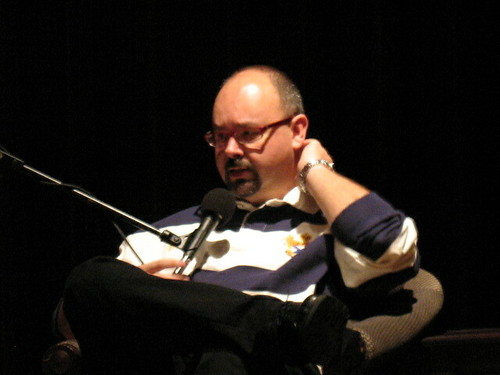
Carlos Ruiz Zafón at International House

Zafón was recently interviewed by 57th Street Books' Tom Flynn, at the University of Chicago's International House.

Comparing The Angel's Game to The Shadow of the Wind, he describe the former as darker, and more complicated, than the latter. They are both parts of what he expects to be a four book "series". "Series" in quotes, because the order of reading is not critical. The experience of the reader will differ depending upon that order, as you combine pieces of a puzzle.


He wanted to use Barcelona as a character. In The Shadow of the Wind, the city was a stagnant, post-Civil War world, while in The Angel's Game, it is a city in turmoil, exploding with the violence of the Civil War to come. The book reflects the darker nature of the times.

In future books, says Zafón, we will learn more about the Cemetery of Lost Books. The idea for that place came to him originally in Los Angeles, a city that made him think about the destruction of memory. Driving around the county, and finding gargantuan second-hand bookstores like Long Beach's "Acres of Books", a store with corridors of books, housing a demonic cat. With the loss of such stores, we lose not just books, but ideas and a sense of identity.


On literature: many people who become writers experience literature as an ungrateful lover. LIterature tries to figure out the basic elements of life. When it works, it helps us better understand ourselves and the world.


What books made an impression on him? The world of books itself, of language, words, style. As a child he read everything. He has never trusted the labels we put on books. In his work, he is trying to communicate respect for books.


On the translations of his books: the translator, Lucia Graves, is the daughter of Robert Graves. She read his books and came to him with the idea of translating them into English, although she had never done so professionally. Reading the first pages she translated, he felt she captured the essence of the his book. They worked together - she would translate, he would review it and provide ideas. (He himself is quite fluent in English.) Says Zafón, you only notice a translation when it doesn't work.


50. The City of Dreaming Books, by Walter Moers

At Lindworm Castle in the country of Zamoria, every young dinosaur has an authorial godfather who is responsible for his literary education and training. When young Optimus Yarnspinner's godfather, Dancelot Wordwright, dies, he leaves his charge a manuscript of such surpassing genius, a piece of writing so perfectly right, that Optimus decides that he must find the author and learn from him.

And so he leaves home and heads for the city of Bookholm, a town that "reeks of old books", where the inhabitants walk with "stacks of books under their arms - indeed, many tow whole handcarts laden with reading matter". But as he begins his search for the mysterious author amid the city's five thousand antiquarian bookstores, it becomes apparent that all is not as it seems. Hidden beneath the city are labyrinthine tunnels where Bookhunters seek rare and precious tomes, and where danger lurks. Optimus finds himself trapped in this nether world, and must find his way back to the light. It is his adventures there that form the core of this delightfully exciting book, as he fends off living books (animatomes), spends time among the Booklings (each of whom has memorized the entire output of such literary geniuses as Aleisha Wimpersleake and Wamilli Swordthrow), and learns the secret of the Shadow King.

An utterly charming and amusing book, filled with literary puns. Many booklovers will appreciate the scene where, hypnotized by an odd form of music, the populace madly invades the bookstores, "sweeping books off the shelves regardless of title or author, price or condition . . . I had been smitten with an insatiable hunger for books and only one thing could cure it: buy, buy, buy!" Sounds like me at the Newberry Library Book Fair.

Monday, February 23, 2009

An Illuminated Life

13. An Illuminated Life: Belle da Costa Greene's Journey from Prejudice to Privilege, by Heidi Ardizzone

It is a rare visit to New York that I do not go to the Morgan Library and Museum. With its extraordinary holdings of illuminated manuscripts, fine bindings, old master prints and drawings, it is a splendid place to while away the hours. Although it was J.P. Morgan's interest and money that began the collection, Belle da Costa Greene, his personal librarian and, later, director of the Morgan Library, was, in large part, responsible for shaping and directing it. He hired her, fresh from Princeton, in 1905, and she remained at the Library until shortly before her death in 1950.

Ardizzone's book concentrates on two main themes: Greene's family background and her love affair with Bernard Berenson.

Greene was born Belle Marion Greener, into a family of color that had been part of the District of Columbia's black élite. Indeed, her father was the first African-American to graduate from Harvard. But when he and her mother, Genevieve, separated, perhaps due to class differences, perhaps because of his political activities in the race arena, Mrs. Greener, by then living in New York, changed her name and she and her children lived as white. Ardizzone is careful to use the term "lived as white" as opposed to "passing" to allow for the very real possibility that they considered themselves white, having a predominantly white ancestry. (Her discussion of the changing "rules" and cultural assumptions regarding racial identity is, indeed, one of the more interesting parts of this book.* ) Belle created the fiction of a Portuguese ancestry to account for her darker complexion, and was often described as "exotic"-looking.

The majority of the book is devoted to Greene's relationship with art historian/art dealer Bernard Berenson, a womanizer of great renown. (Berenson's wife, Mary, vacillated between being a facilitator of his relationships, and getting depressed and angry over them. What a household!) Belle differed from Berenson's other women, though, in that she was a career woman. She couldn't (and wouldn't) drop everything to be with him, and over the years they were apart more than they were together. Although each had needs and desires that the other could not fulfill, their influence on each other was enormous. (Sadly, while her letters to Berenson were saved, his to her were lost when she chose to destroy her personal papers before her death. It is to Ardizzone's credit as an historian that she has been able to write such a credible account of this relationship sans those documents.)


Greene, dubbed by the press the "glamorous librarian", was a mass of contradictions (but then, aren't we all?). She was close to her family, living with them and often being the sole, or major, financial support. Yet she seems to have kept them quite separate from her professional life. She lived as white, but frequently made veiled references to her black ancestry (and surely, if she were open about this, it would have negatively affected her in her profession). She had a tumultuous affair with Berenson, as well as relationships with other men, but the times required that she be as discreet as possible. Despite having made her way in the professional world, she was ambivalent about suffrage and the women's rights movement.


Although Ms. Ardizzone is often repetitious in making her points, her subject matter is so interesting that it really doesn't matter. What does matter is that I missed any real sense of how and why Greene became such a powerful figure in her world of book and manuscript collectors. I wanted more about her work, more about her influence on the development of Morgan's collection, more about how she gained her own expert knowledge. Nevertheless, Ardizzone has written a compelling personal biography about a fascinating woman.

*As it happens, while I was reading this book I saw an exhibit at the Museum of Contemporary Art which included a piece by Adrian Piper, Cornered, on this very theme. Addressing the viewer in video, Piper challenges us to consider our assumptions about how we identify ourselves and others racially. On the wall are two birth certificates for Piper's father, issued a couple of decades apart: one identifies him as "mulatto", the other says that he is "white". Appearance often trumped the "one drop" rule (the laws that said "one drop" of Negro blood made a person black). Indeed, the historic Plessy v. Ferguson decision of the United States Supreme Court, allowing legally mandated segregation, arose from a challenge to such laws in which African-Americans sought to show the illogic of such segregation by the very fact that Mr. Plessy had to tell the train conductor that he was not white. Years later, Mr. Plessy self-identified as white in order to vote.