Showing posts with label literary mysteries. Show all posts

Saturday, March 27, 2010

The God of the Hive

17. The God of the Hive, by Laurie R. King

If you read my review of King's last book, The Language of Bees, you'll understand why I approached this book with some trepidation. But after some initial concern, I found that my fears were unjustified.

For those unfamiliar with King's Mary Russell series, know that she has married off inveterate bachelor Sherlock Holmes to a woman much younger than, but just as intelligent as, he. In her last, she also gave him a son by Irene Adler, as well as a daughter-in-law and granddaughter. So purists need not apply! And if you haven't read the last book, and don't want to know, read no further, because I have to give away some of that plot to discuss The God of the Hive. You have been warned!

When we last saw Holmes and Russell, they had rescued his granddaughter and his wounded son Damian, leaving for dead (or so they thought) the cult leader who had murdered Damian's wife as well as several other people. Circumstances had made Damian a suspect, and a warrant had issued for his arrest, as well as for the arrests of Sherlock and Mycroft Holmes, and Mary Russell.

The tale continues, told from several points of view. Holmes has taken his son off by boat, picking up a stray female physician along the way, and gone to ground in Holland. Mary and the child Estelle have found their pilot, and are flying off, but someone shoots at the plane, wounds the pilot, and they are forced to land in a forested area where they meet, and are assisted by, an odd man who goes by the name of Robert Goodman. In London, meanwhile, Mycroft has been kidnapped, and is being held prisoner by persons unknown for reasons unknown.

All roads, in this case, lead to London, as Holmes and Mary try to re-connect via the agony column of the Times, staying one jump ahead of the evildoers trying to find them, while Mycroft tries to figure out where he is and why. All sorts of complications arise. If the plot sounds rather intricate, that's because it is, and if I have any criticism at all, it's that the plot is a mite confusing at times (but that's the Intelligence Service for you!), and there are rather too many new characters introduced, some of whom, if you've read Dr. Watson's memoirs, you may have heard of before.

But King is a master of misdirection, and of story-telling. In Robert Goodman particularly, King has created a very intriguing character, the disaffected scion of a noble family and shell-shocked veteran ("that old responsibility dream" as Peter Wimsey once said). Indeed, I think my favorite parts of this book were those with Mary, Estelle and Robert, learning more about him, and watching his easy play with the child.

So I'm happy to say that, unlike with her last, I did find this one satisfying, and can say that King is back on track, and I am looking forward to more, particularly if the end presages what I hope it does.

Saturday, March 6, 2010

Locked In

13. Locked In, by Marcia Muller

The 27th Sharon McCone mystery finds McCone hospitalized, paralyzed by a gunshot wound to the head, in a "locked-in" state, meaning that she can hear, she can think, but she cannot move or talk. At best, she can respond by blinking - once for "yes", twice for "no".

Her colleagues gather to try to find out who attacked her, delving through old files on the not unreasonable assumption that this was likely related to one of her old cases.

Ordinarily, Muller writes from McCone's point of view. But because of the situation in which she has placed her protagonist, this book is written from multiple points of view. It's a departure which I found interesting, and which worked, particularly as we also got inside Sharon's head as she responded mentally to what she was being told by others. Muller really captured the frustration that someone who is "locked-in" must feel, particularly if that person is ordinarily as physically and mentally active as McCone.

Although some McCone fans may feel there is not enough of her in this novel, I liked this unexpected twist.

Sunday, February 28, 2010

Heresy


12. Heresy, by S. J. Parris

This much is true: Giordano Bruno did go to Oxford in the spring of 1583, in the party of the Prince Palatine Albert Laski and Sir Philip Sidney, where he did engage in a debate on the Copernican theory.

On this thread, S.J. Parks (pseudonym of journalist Stephanie Merritt) has hung her murder mystery. The book opens as Bruno flees his monastery with the Inquisition nipping at his heels. We next see him on his way to Oxford, having traveled far both geographically and socially. By now he had become quite well-known as a lecturer in mnemonics and as a theologian, enjoyed the protection of Henri III, and, in fact, lived in England at the home of the French Ambassador, Michel de Castelnau.

At Oxford, he is immediately confronted with the effects that religious differences in England have had there. Though the Queen sought to consolidate Protestantism there through the appointment of Robert Dudley, Lord Leicester, as chancellor, previous Marian appointments meant that there was still Catholic presence there, and concerns about treason and espionage were not entirely unjustified. Bruno, as an excommunicate, would be unsympathetic to the papist cause, yet because he was a former monk and an Italian, many English Protestants would be suspicious of him.

Bruno has not been in Oxford long when his preparations for the disputation are interrupted by horrific screams, screams that turn out to be from the sub-rector, whose throat is being torn out by an Irish wolfhound. But how did the dog get into an enclosed, locked garden? Bruno is suspicious that this is not an accident. When he finds in the man's room a journal dated using the Gregorian calendar, and in that journal a cipher in invisible writing with the phrase "ora pro nobis", he is sure that something is amiss. A second murder follows hard on the first, and Bruno is plunged into religious and political intrigue.

I will say that I am not ordinarily a fan of books that use well-known historical (or, for that matter, literary) characters as detectives. And, frankly, the part of this book relating to the actual working out of the mystery was the least satisfying. (Honestly, there really aren't a whole lot of murderers who engage in the sort of intricate "message-sending" sort of murders that occur here.) I was much more interested in the playing out of the religious and political tensions between Protestant and Catholic, English and continental European, and how that affected life in Oxford, both for town and gown.

That said, it's quite a well-written book and I'd recommend it to anyone who enjoys mysteries set in Elizabethan times. Me, I've plucked John Bossy's Giordano Bruno and the Embassy Affair off the shelf on which it has been languishing and will let you know whether Bruno really was a spy!


Wednesday, February 24, 2010

Mysterious!


8. Shooting at Loons, by Margaret Maron

An early Deborah Knott mystery, which somehow had escaped me! Knott, now judge, has been seconded to a town on the Outer Banks of North Carolina to fill in for an ailing colleague. She and a local boy head out looking for clams, and discover a body instead. And, of course, it won't be the only one.
The hook in this book is the tension between local fishermen and developers, wealth and the struggle to survive, rigidity and compromise, and the odd alliances that are often found in politics. As with all Maron's Deborah Knott books, this one is as much about place as it is about people, and it tells us a story about change and growth and North Carolina at the same time as it's telling us a story about murder and mayhem.


9. The Dain Curse, by Dashiell Hammett

Head to the west coast, where the Continental Op is called in to figure out a burglary and diamond theft for his insurance company employer. A suspect turns up dead, but without the diamonds. Then the guy who was burgled commits suicide, or maybe it wasn't. And he's got a wife who's behaving oddly and a daughter who is gorgeous, troubled, addicted to morphine and pretty sure that she's the victim of a family curse.

Things just keep happening here. Once you think everything's resolved, something pops up, generally a dead body. It's Hammett at his hard-boiled best.


10. Frontera Dreams: A Héctor Belascoarán Shayne detective novel, by Paco Ignacio Taibo II

I am so glad I picked up this book! This is actually the seventh book in the series, the fifth that's been translated into English, but there's a hugely informative essay at the beginning that fills the reader in on what went before. You need to know that Héctor has a body "impervious to wounds", that he was killed and resurrected.

When Héctor was a teenager, he had a sweetheart. Now she's a famous movie star, except that she's disappeared, and his daughter comes asking him to find her. This is about the literal frontera, the U.S.-Mexico border, but also the borders of reality and dreams, past and present and future, who we are and who we were and who we want to be. There are whores and narcotrafficantes, people who still have dreams and people whose dreams have died.

It's too bad that not all of Taibo's books have been translated, but you can bet I'll look for the rest that have been.


11. Talking Mysteries, by Tony Hillerman and Ernie Bulow

If you're a Tony Hillerman fan, I urge you to find this book. The bulk of it is an interview of Hillerman by Bulow, about Hillerman's work, how he came to set his books in Navajo country, how he writes, a lot of great stuff about the process of writing that should be of interest even if you're not a Hillerman devotée. There's also an essay by Hillerman on similar themes; a short story, a "Jim Chee mini-mystery"; and several drawings by Ernest Franklin, originally intended for one of Hillerman's books. This is a great glimpse into how an author works, where his ideas come from, and how he makes those ideas flesh.

Sunday, February 14, 2010

Murder in the Rue Dauphine

6. Murder in the Rue Dauphine, by Greg Herren

Chanse MacLeod used to be a New Orleans police officer. Now he's a private detective. One day, he's hired by a young gay man, Mike Hansen, to try to find, and stop, the person who is blackmailing Mike and his older, rich, closeted lover. Before Chanse can get his teeth into the case, though, Mike is murdered, and the words "Faggots die" is written in blood on the wall. Though MacLeod (and the police) believe that the murder is more likely connected to the blackmail, the leader of a local gay rights organization insists that it's a gay bashing, and begins to politicize the murder. Then MacLeod, and the victim's neighbor, are shot at by someone shouting "Die faggots", and he begins to wonder.

Now, I have to admit that I figured out a good bit of what was going on before the end, but, after all, I've been reading mystery novels for literally decades, so I have a pretty good idea of what to expect. But there were some twists and turns here, and I do appreciate the fact that Herren doesn't fall back on the culprit or culprits' confession to solve the case.

This being the first of a series of Chanse MacLeod mysteries, we get a fair bit of back story about Chanse and the woman in his life, his reporter friend Paige Tourneur. Chanse has also just begun a relationship with Paul, a flight attendant, and I thought Herren did a masterful job of showing Chanse's ambivalence about it, from worrying that Paul might have a boyfriend in every airport to the opposite worry that Paul might be falling in love before Chanse is ready.

There's a long list of writers in the acknowledgements, and many of them are people whose work I've enjoyed over the years*. So to know that people like Julie Smith and Dorothy Allison saw something in Herren's work was certainly an incentive to read this. They weren't wrong.

*Story! Several years ago, I wandered into the Faubourg Marigny Bookstore (and could someone please design them a website, please?) looking for a book to read on my flight home. I was looking specifically for a book by Katherine V. Forrest, which they didn't have. But the young man suggested that I try instead Death by the Riverside, by a local writer, J.M. Redmann. Great book, and ever since then I've been hooked on the concept of looking for local authors wherever I travel.

Sunday, October 18, 2009

The Language of Bees

77. The Language of Bees, by Laurie R. King

Although I am not ordinarily fond of books that take a well-known character of another author and place him (or her) in a situation that the originating author would have found ludicrous, it is nevertheless the case that I enjoy King's Mary Russell series, despite the fact that she has contrived to marry off Sherlock Holmes. That in itself is quite contrary to Holmes' nature as created by Sir Arthur Conan Doyle, but, on top of that, she marries him off to a woman far younger than himself. And in this book, she has given him a son by Irene Adler (a/k/a "The Woman").

Russell and Holmes have returned to Sussex following a lengthy sojourn abroad (the details of which are available in King's previous books). One of Holmes' bee colonies has been engaging in very odd swarming behavior, but more seriously, his estranged son, a brilliant Surrealist painter, appears to announce that his wife and young daughter have disappeared. Mary and Holmes proceed to investigate, with Holmes attempting to do so while keeping his relationship with Damian Adler secret. Yolanda Adler's background is a dubious one, to say the least. That, as well as Damian's past involvement with the law, former drug addiction and shell-shock (what we would call Post-Traumatic Stress Disorder) from his war experiences, cause suspicion to fall upon him when his wife's body is found. It appears that her murder may be related to other odd murders that have been occurring.

Although this book was a compelling read, it was, ultimately, a bit unsatisfying. For one thing, I am a bit tired of mysterious cults, and I'm afraid we're going to get more of the one that King created for this book. More seriously, though, is the fact that too many threads were left hanging, too many questions remain unanswered.

So only a mild recommendation.

Thursday, August 13, 2009

Boston Books

I've just spent a glorious week in Boston, and naturally prepared by reading books set there, about there, and so on. And took some to read while there and on the plane. So I have much to review!

To begin, there is, apparently, something about Boston that leads murderers to choose extremely bizarre methods of offing their victims. Two of the books I read were mysteries, and both involved very odd forms of murder. One cannot, it seems, eliminate a Boston Brahmin with nothing more than a bullet to the head or a simple stab wound. Oh, no! That would be déclassé.

57. Coign of Vantage, or the Athenæum Club Murders, by John McAleer

Someone is killing members of Boston's venerable Cart-Tail Club. The book begins with one member being knocked unconscious and locked in a freezer, where, of course, he suffocates. We learn that other members of the club have died in what had been written off as accidents. Our hero, who has just been proposed as a member, is a probabilities expert, and is asked to solve the mystery (discreetly, please, as befits a venerable Boston club).

It turns out that the murders are all connected to a woman who wrote pulp fiction years earlier, her work all based on secrets and transgressions of ancestors of the murder victims.

The motive ultimately makes little sense and the book is hard to get into. Too many characters are introduced too quickly, with too much esoteric gabbing. But once past that, it's rather amusing, though the satire is probably best appreciated by Bostonians.

58. The Dante Club, by Matthew Pearl

There really was a Dante Club, with many of Boston's 19th-century literary élite, that worked with Henry Wadsworth Longfellow on his translation of the Divine Comedy.

In Pearl's mystery, which ranges throughout Boston and Cambridge, the Club tries to solve the murders of various Boston brahmins, murders that are very specifically, and down to the last detail, replications of the punishments of sinners described by Dante in The Inferno.

The solution is not satisfactory - it's complicated and quite a stretch - and I'm not terribly fond of books that attempt to place historical characters out of their milieu. That said, however, Pearl does a decent job of evoking the atmosphere of Boston in 1865, particularly the "town and gown" conflicts and the aftermath of the Civil War. And certainly you will learn a great deal about Longfellow and the other members of the Dante Club, probably more than when you had to memorize their poetry in school (or am I dating myself? do you have to do that now?).

59. The Silent Traveller in Boston, by Chiang Yee

Chiang Yee was a Chinese scholar, poet, painter and calligrapher, who taught Chinese first in England, and later in the United States. Over a period of about four decades, he wrote the "Silent Traveller" series, describing his travels in various countries and cities around the world.

The Silent Traveller in Boston was published in 1959, but Yee's descriptions of the important landmarks of Cambridge and Boston are still relevant. I was glad that I had read of his visit to the Isabella Stewart Gardner Museum, though I envied him his invitation to dine there!

It was most interesting to read Yee's comparisons of American and Chinese ideas and customs, as when he contrasts the New (and Old) England concept of witches with the Chinese. (At the end of the book, he comments on the McCarthy-ite "witch" hunts earlier in the '50s, and notes that Joseph Welch was a Bostonian and that "[t]he Boston spirit of love of universal liberty had acted again."

Yee has the artist's eye for detail, and he continually surprises by what he notices and the relationships that he sees. He has an intense curiosity and desire to learn all about the places that he visits, and we are fortunate that he shares his what he learns, and, more so, what he thinks, with us. The books are greatly enhanced by Yee's illustrations, both full page color pictures and black-and-white drawings, as well as poems which are given in both English and Chinese.

If you are visiting a city which Yee included in his "Silent Traveller" series, I would strongly recommend that you find a copy of his book and read it before you go.

60. Isabella Stewart Gardner Museum: Guide to the Collection

This guide is an absolutely indispensable adjunct to a visit to the Gardner Museum.

Mrs. Gardner opened her museum in 1909. When she died in 1924, her will provided that nothing be changed or moved. All was to remain as she had left it. There was method in this, as she was an absolute genius at installation, and when she placed an item, she had a reason for that placement, particularly in its relation to other objects.

But there are no wall signs and the one page guides available in some of the rooms are not as detailed as one might like. And not all the rooms have them. Although this slim volume does not contain every item, either (well, there are a couple of thousand!), it does cover more of them, and gives more information. Because nothing can be moved, the guide can be very explicit as to where everything is located in a room or gallery. (My edition is from before the 1990 robbery, so it includes the stolen items. How sad to see an empty frame or a card saying "stolen". Someday an obsessive art collector will die, and his heirs, I hope, will return the ill-gotten goods.)

There's a short, but useful, biographical sketch as well, that will likely leave you wanting to learn more about this dynamic woman. If so, I'd suggest Douglas Shand-Tucci's biography, The Art of Scandal: The Life and Times of Isabella Stewart Gardner and Elizabeth Anne McCauley's Gondola Days: Isabella Stewart Gardner and the Palazzo Barbaro Circle.


61. The Complete Guide to Boston's Freedom Trail, by Charles Bahne

The Freedom Trail is a two and a half mile trail, marked by red brick along Boston streets, that takes you to some of America's most historic places, such as Old North Church ("one if by land, two if by sea"), Faneuil Hall, and the site of the Boston Massacre.

This little book is splendid, particularly for the individual who prefers to go it alone. A starting point at Boston Common is suggested, and directions are given from there. But the book is hugely informative, with lots of history told in an interesting manner. I particularly appreciated the extensive detail about who is buried in which burying ground. There is a good map, a list of hours and admission fees, information about wheelchair access, and the like.

My copy is the second edition, published in 1993, which I picked up at a used book sale shortly before my trip. I did not, however, encounter any outdated information, other than the fact that the "Big Dig" is now over with!


62. The Wordy Shipmates, by Sarah Vowell

Who were the Puritans? What did they really believe? Would you really want them living next door to you?

What you were taught in school about the Puritans and the settling of the Massachusetts Bay Colony is mostly bunk. There's a grain of truth in the "fled England to escape religious persecution", but only a grain. They believed in religious freedom - if you believed as they did. They were a bunch of contrary, ornery, fascinating folk.

Vowell's book brings to life these people who live in dry and dusty textbooks, warts and all. She does so with style and mordant humor. An excellent and enjoyable read.

Sunday, July 19, 2009

Authors beware!

I often read more than one book at a time. Recently, both books I was reading were Dreadful Warnings to Would-be Authors! Well, not really, but the protagonist of each was a writer who, in the course of trying to achieve success, encountered malevolence. While each book was actually quite different, each contained elements of fantasy or the supernatural. And each was excellent in its own way.


49. The Angel's Game, by Carlos Ruiz Zafón

Anyone who loved Zafón's The Shadow of the Wind will be enthralled by this story of a young journalist who, after having made his name writing pulp fiction, is hired by a mysterious publisher to create the founding scripture of a new religion. Set in Barcelona in the 1920, the novel follows the career of David Martín as he becomes entranced by the beautiful Cristina Sagnier and ensnared by Andreas Corelli of Éditions de la Lumière.

We again find ourselves visiting the Cemetery of Forgotten Books, where Martín chooses (or is chosen by) a book called Lux Aeterna. (Odd coincidence: I reached this point in the novel just after listening to Morten Lauridsen's Lux Aeterna on the radio.) He soon learns that the author lived and worked in the house that he himself has bought, but the connections are, in fact, deeper and odder. As Martín hunts for information about that author and his strange employer, he is plunged into mystery upon mystery, and with him we haunt the dark side of Barcelona and of life.

Along with the darkness are humorous bits. When Martín ghostwrites a novel for a wealthy friend that is published at the same time as his own maiden effort under his own name, Zafón takes a jab at critics, as the former that is praised as "a mature, rich work of great quality" while the latter is dismissed as "perhaps this year's worst literary debut". Venal publishers come in for a bit of sniping, as well.

I think that it will be hard for Zafón to top Shadow of the Wind, but The Angel's Game is certainly a fine second novel.


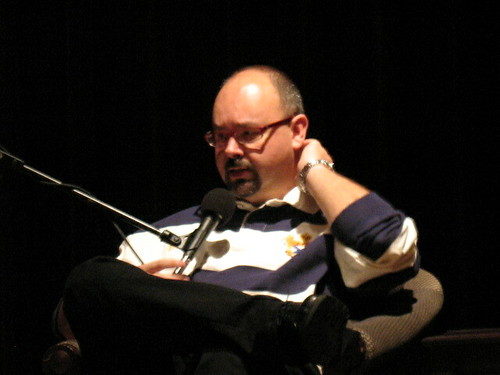
Carlos Ruiz Zafón at International House

Zafón was recently interviewed by 57th Street Books' Tom Flynn, at the University of Chicago's International House.

Comparing The Angel's Game to The Shadow of the Wind, he describe the former as darker, and more complicated, than the latter. They are both parts of what he expects to be a four book "series". "Series" in quotes, because the order of reading is not critical. The experience of the reader will differ depending upon that order, as you combine pieces of a puzzle.


He wanted to use Barcelona as a character. In The Shadow of the Wind, the city was a stagnant, post-Civil War world, while in The Angel's Game, it is a city in turmoil, exploding with the violence of the Civil War to come. The book reflects the darker nature of the times.

In future books, says Zafón, we will learn more about the Cemetery of Lost Books. The idea for that place came to him originally in Los Angeles, a city that made him think about the destruction of memory. Driving around the county, and finding gargantuan second-hand bookstores like Long Beach's "Acres of Books", a store with corridors of books, housing a demonic cat. With the loss of such stores, we lose not just books, but ideas and a sense of identity.


On literature: many people who become writers experience literature as an ungrateful lover. LIterature tries to figure out the basic elements of life. When it works, it helps us better understand ourselves and the world.


What books made an impression on him? The world of books itself, of language, words, style. As a child he read everything. He has never trusted the labels we put on books. In his work, he is trying to communicate respect for books.


On the translations of his books: the translator, Lucia Graves, is the daughter of Robert Graves. She read his books and came to him with the idea of translating them into English, although she had never done so professionally. Reading the first pages she translated, he felt she captured the essence of the his book. They worked together - she would translate, he would review it and provide ideas. (He himself is quite fluent in English.) Says Zafón, you only notice a translation when it doesn't work.


50. The City of Dreaming Books, by Walter Moers

At Lindworm Castle in the country of Zamoria, every young dinosaur has an authorial godfather who is responsible for his literary education and training. When young Optimus Yarnspinner's godfather, Dancelot Wordwright, dies, he leaves his charge a manuscript of such surpassing genius, a piece of writing so perfectly right, that Optimus decides that he must find the author and learn from him.

And so he leaves home and heads for the city of Bookholm, a town that "reeks of old books", where the inhabitants walk with "stacks of books under their arms - indeed, many tow whole handcarts laden with reading matter". But as he begins his search for the mysterious author amid the city's five thousand antiquarian bookstores, it becomes apparent that all is not as it seems. Hidden beneath the city are labyrinthine tunnels where Bookhunters seek rare and precious tomes, and where danger lurks. Optimus finds himself trapped in this nether world, and must find his way back to the light. It is his adventures there that form the core of this delightfully exciting book, as he fends off living books (animatomes), spends time among the Booklings (each of whom has memorized the entire output of such literary geniuses as Aleisha Wimpersleake and Wamilli Swordthrow), and learns the secret of the Shadow King.

An utterly charming and amusing book, filled with literary puns. Many booklovers will appreciate the scene where, hypnotized by an odd form of music, the populace madly invades the bookstores, "sweeping books off the shelves regardless of title or author, price or condition . . . I had been smitten with an insatiable hunger for books and only one thing could cure it: buy, buy, buy!" Sounds like me at the Newberry Library Book Fair.

Thursday, June 18, 2009

Stone's Fall


39. Stone's Fall, by Iain Pears

Do not be afraid of this book's 800+ pages! Because it is a page-turner.

It begins in a cemetery, at the funeral of one Mme. Robillard. Matthew Braddock, who knew her under another name, in another time, in another place, is approached by a representative of her lawyers' who informs him that the firm is holding a parcel intended to be given him only upon Mme. Robillard's death. But it will be another 300 or so pages before we learn the contents of that parcel. First, Braddock must tell us the story of how he met Mme. Robillard, or Elizabeth, Lady Ravenscliff, as she then was.

That story begins in London, in 1909, when Braddock she hires Braddock to investigate the mysterious death of her husband, financier and arms dealer John Stone, Lord Ravenscliff. As he delves into the case, he finds complex layers of intrigue and, not incidentally, falls in love with the widow Ravenscliff. Naturally enough, neither she nor Ravenscliff, nor any of their colleagues, is what they at first appeared to be. So dramatic and compelling and complete a story is this narrative that, at the end, I found that I had forgotten that parcel and was startled to find that I was only one-third through the book.

The second part moves back in time, beginning in Paris in 1890, and is the story of one Henry Cort, who had become known to Braddock during his investigations. Another mysterious figure, to say Cort was an intelligence operative for the British government is to understate the case. His parcel contains his narrative of his own life, and how he came to his position, and how he knew Lady Ravenscliff, before she was a lady at all.

It also contains certain documents of John Stone's, documents that had gone missing at his death. These form the third part of Pears' novel, and go back even further in time, to Venice, 1867, where Stone's enterprise begins. And it is here that we learn the real history of Elizabeth, and the reason and manner of Stone's death. It will, I think, be a surprise.

Those familiar with Pears' An Instance of the Fingerpost will, however, not be surprised at his ability to take multiple strands of narrative and weave them into a complicated, yet understandable, whole. Like the best Victorian triple-deckers, Stone's Fall is full of surprises, twists and turns, but it hangs together logically. Even more than this, Pears creates characters who engage our sympathy, even if their actions do not. Like real people, their psychology is not simple, and their motives are mixed. Some do good for bad reasons, and some act badly for good reasons. Some act for no reason, but emotionally. Just like you and me.