Showing posts with label biographies. Show all posts

Saturday, July 10, 2010

E.M. Forster, by Richard Canning


E.M. Forster, by Richard Canning

This short biography of E.M. Forster, part of Hesperus Press' "Brief Lives" series, is an excellent one. It is not, nor is it intended to be, an authoritative work on Forster's life and work. It is, however, a good introduction. In a strictly chronological way, Canning hits the high points, and in so doing, he provides insight into Forster's life, his relationships, public and private.

There's very little discussion of Forster's works, except insofar as they fit within the biographical story. Indeed, if there is any part of the book that could have been elimnated, it is the short last chapter, Afterlife, which is as close as Cannign comes to literary criticism. It seems oddly out of place.

While those who have read Forster will naturally find more in this book than those who have not, it can be read with appreciation by anyone, and any reader will find it informative. Definitely recommended.

Sunday, October 11, 2009

On Jane Austen

74. Jane Austen: A Life, by Claire Tomalin

If you read only one biography of Jane Austen, read this one. It's not only extraordinarily well-researched, it's as readable as Austen herself. Witty, detailing the Austen family's daily life, not shirking at scandal (cousin Elizabeth may have really been the daughter of Warren Hastings) and never presenting speculation as fact (though not failing to provide factual support for what speculation there is), Tomalin gives great insight into Jane Austen. She does not make the mistake of assuming that Austen's books are biographical, but does show how Austen (not unlike most authors) has taken the threads of her life, her friends and family, and woven from the briliant tapestry of her novels.

Tomalin provides a good deal of information not only about the Austens, but about the world in which they lived, what was happening in it of political importance, what life was like for the different classes, how people lived. Interspersed with the biographical material are thoughtful analyses of Austen's works, and Tomalin shows with great clarity how Austen's fictional world meshes with the one in which she led her life. This really should be required reading for anyone who complains that Austen doesn't share the modern view of what a woman should think and feel and do.

This is a truly impressive undertaking, and one which has well succeeded. Tomalin makes us feel that we know Jane Austen, the girl and the woman, as well as her relations and relationships, and, in so doing, allows us to take our well-read copies of the novels down from our bookshelves and re-read them with greater insight and appreciation.


75. Letters to Alice on First Reading Jane Austen, by Fay Weldon

Weldon's imaginary niece, Alice, wants to write a novel. What she doesn't want to do, despite doing a college course in English Literature, is read Jane Austen. Weldon sets out to show her why she should.

Weldon, as a novelist, has a rather different take on some of the received wisdom about Austen. She refers to James Austen-Leigh's famous comment about Austen covering her work when others entered the room, which has led some to speculate that she was ashamed of her work. Weldon notes that "[m]ost writers choose to cover their work when someone else comes into the room", not wanting to answer questions such as "And who is this Mr. Knightley?" One of the most delightful things about this book is to read a writer's take on Austen and her work and works.

But that's not all. Her description of Literature as a "City of Invention" is one of the best things I've read in a long time. Books are the buildings, writers the architects. I'm sure we can all name a few books that fit this description: Sometimes you'll find quite a shoddy building so well placed and painted that it quite takes the visitor in, and the critics as well - and all cluster round, crying, 'Lo, a masterpiece!' and award it prizes. But the passage of time, the peeling of paint, the very lack of concerned visitors, reveals it in the end for what it is: a house of no interest or significance.

Friday, September 11, 2009

Louisa May Alcott: the Woman Behind Little Women


68. Louisa May Alcott: the Woman Behind Little Women, by Harriet Reisen

Could any woman with a shelf full of books by and about Louisa May Alcott resist a new biography* of her? What about one who devours Little Women and other titles yearly? Who is known to have corrected a docent at Orchard House who mistakenly called Beth the youngest of the March sisters? One who thrilled to the discovery of Alcott's thrillers, and leapt on a previously unknown (to her) bit of juvenile fiction? (A pause here to give thanks to the late Madeleine B. Stern.) This one couldn't. And pleased I am that I gave way to the blandishments of Amazon Vine, because this is a marvelous addition to the aforesaid shelf.

Louisa May Alcott was the second of four daughters born to the Transcendentalist philosopher, Bronson Alcott, and his wife, Abigail May Alcott (Abby). Alcott was one of those men with grand ideas and a head in the clouds, but little practical sense. (It has been fashionable to view Bronson Alcott as a bit of a villain in relation to his family, particularly Louisa. Reisen, I think, gives a more balanced portrait of him. Her description of his ups and downs, and the family history, suggests the possibility of bipolar disorder or depressive episodes, but she quite rightly does not draw that conclusion.)

So the family's financial situation was always unstable, and, as a result, so was their living situation. They moved four times in the first year and a half of Louisa's life, and many more after that. While living in poor circumstances themselves, the Alcotts had wealthy relatives, and that contrast clearly affected Louisa. She was driven to succeed, at least in part, to provide for her parents (particularly the beloved Abby) and sisters. But where the real Alcott wealth lay was in the life of the mind, in their connections to the intellectual and literary world of the New England of their day. They had regular and intimate contact with people such as Ralph Waldo Emerson, Henry David Thoreau, Margaret Fuller and others, who would appear, sometimes only slightly disguised, in Louisa's fiction.

Reisen does not merely tell us how Louisa lived. She also does an exemplary job of showing how that life, and the people with whom she shared it, showed up in her books. And she shows, too, how Louisa's day-to-day life affected what and when she wrote. Those blood-and-thunder thrillers, written as "A.M. Barnard" and rediscovered by Stern and Leona Rostenberg, helped fill the family coffers when times were tight, but they also gave Louisa an outlet for her desire for adventure and action, something difficult for a young woman of her class and time to find in the real world. She couldn't fight a war (though she could nurse, to the detriment of her own health), she couldn't run away to sea or "go west, young man!", but she could write.

In later life, Louisa suffered greatly from a variety of medical problems. Reisen revisits, with the assistance of medical experts, the question of what caused these problems and (ultimately) her death. Louisa herself, and her doctors, attributed her troubles to mercury poisoning resulting from the use of calomel as a curative during her service as a nurse. The doctors Reisen consulted show, quite conclusively, that this is not the case, and she posits that Alcott may have been suffering from lupus. Her arguments are convincing, but, again, she rightly does not insist upon the diagnosis.

Written in connection with the PBS documentary of the same name, this book is extremely well-researched and documented**, with an extensive bibliography and notes. It is one that I would recommend to anyone who has loved Alcott's work.


*Kudos to Reisen for correcting, on her LibraryThing profile (and elsewhere, for all I know), the publisher's erroneous cover blurb describing this as "the first complete biography" of Alcott.

**Here's serendipity for you! The late Madelon Bedell, in her book The Alcotts: Biography of a Family, makes reference to an interview she conducted with the then-96-year-old Lulu Neiriker Rasim, Louisa's niece. Try as she might, Reisen couldn't find the interview or a surviving Bedell. Then, well, let Reisen tell it: "One day I picked up a used copy of The Alcotts, and out of it tumbled a carbon copy of an August 1980 letter written by Bedell herself to Michael Sterne, then the travel editor of the New York Times, proposing a story. At the bottom of the letter was a return address in Brooklyn where, more than two decades later, Madelon Bedell's widower still lived." He helped Reisen locate and recover Bedell's papers, now on their way to Orchard House.

Sunday, July 19, 2009

The Last Trials of Clarence Darrow

51. The Last Trials of Clarence Darrow, by Donald McRae

If you are going to write a biography of someone who has been the subject of as many books as Clarence Darrow has, it's not enough to write well. You'd better have something new to say. Unfortunately, McRae, while a decent enough writer for the most part, does nothing to add to our knowledge or understanding of Darrow.

For many years, Darrow carried on an extramarital relationship with journalist Mary Field Parton. He was clearly the love of her life (despite her marriage to Lemuel Parton); whether she was the love of his is not, I think, as clear as McRae suggests. McRae has taken this relationship, using Parton's diaries, letters between Darrow and Parton, as well as writings and interviews with Parton's daughter, Margaret, and has set it as a framing device for his description of three of Darrow's most famous cases, cases that came towards the end of his legal career.

The difficulty is that those cases (the Leopold-Loeb sentencing hearing, the Scopes trial and the murder trial of Ossian Sweet and his co-defendants) have been written about at great length. Here's one bibliography regarding Scopes, and this was compiled more than ten years ago! And the same source on Leopold and Loeb. Although writings about the Sweet case are not as extensive, they are readily available.

If the Parton connection had any relevance to, or effect on, Darrow's participation in, or conduct of, these cases, then the device would work. But, if she did, it is not apparent from McRae's book. For the most part, he simply quotes her diaries or her daughter's writing as to what she was feeling at the time of the events, or engages in speculation as to her or Darrow's reactions. Further, he takes Mary and her daughter (who was quite young at the time of these events) at face value, without seeming to take into account their biases. Should we really assume that Mary is correct in her assessment of Darrow's wife, Ruby, and his satisfaction or lack thereof in his marriage, when she wanted to be married to him herself? People are not generally objective about their rivals in love!

I have the sense that McRae thought there'd be a book in Darrow's relationship with Parton, but found that there simply wasn't sufficient source material to write a full-length book. So he used it as padding. This would have been far better off as an article in a periodical such as The New Yorker.

Finally, I am tired of non-fiction writers who really want to be novelists. Non-fiction is about fact. It is not about pretentious, overblown invention. The opening paragraph of the book gives a broad hint of problems to come. I have to quote that paragraph in full, with my comments, so you'll see what I mean:

"Darkness spread slowly across a city in tumult. It seeped through the burnt orange and faded [is that a verb or an adjective?] red streaks of a sky that softened the stone buildings towering over her [Who is "her"? The "darkness"? The "city"?] Alone in the Loop on a summer evening [well, that's arrant nonsense to anyone who knows the Loop!], Mary Field Parton picked her way through the teeming streets, slipping quietly past the blurred faces and babbling voices. [Wait! What happened to "Alone in the Loop . . . ?"] And the farther she walked the more she lowered her gaze, as if willing herself to become invisible. The dusk framed her own trepidation [huh?] as she went to meet the man she had loved so long."

Writing like this is guaranteed to lose me from the start.

Thursday, April 2, 2009

Passing Strange

22. Passing Strange: A Gilded Age Tale of Love and Deception Across the Color Line, by Martha A. Sandweiss

When Clarence King died in Phoenix, Arizona, in 1901, he was eulogized by friends like John Hay, private secretary to Abraham Lincoln and Secretary of State under McKinley and Theodore Roosevelt, and historian and memoirist Henry Adams. He was remembered as the first director of the United States Geological Survey, the man who exposed a diamond hoax that threatened the economy of the United States, a devoted son and confirmed bachelor.

He was all those things, except the last. The man who, in 1880, said that he had lost the only woman he had ever wanted to marry through too much attention to duty, in 1888 married a woman so far outside his social circle and standing that he did so under a false name, a false occupation, a false identity and a false race. For Clarence King, son of a prosperous China trader, interlocutor of Ruskin and Turner, guest at the White House, had fallen in love with Ada Copeland, an African-American woman born into slavery. He courted her under the name "James Todd", and told her he was a Pullman porter, a job which must mean that he, too, was African-American.

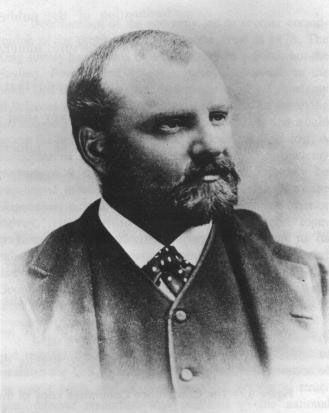
How this blond, blue-eyed man passed as black is more than a story of love and deception. It is the story of how this nation has interpreted race and how social and cultural assumptions translate into racial "certainties". It was interesting to compare how King used those assumptions to pass as black with way in which Belle da Costa Green used them to live as white (see An Illuminated Life). Although in some parts of the world distinctions were and are drawn between "white", "black" and mixed race ("colored", "mulatto" "mestizo"), in the world of Clarence King/James Todd any black ancestor made you black, no matter how you looked. At the same time, people took their cues about someone's race from their surroundings. So King, looking like this:


could be perceived as "black" simply because he was met in an African-American neighborhood, visited an African-American church, and claimed to be a Pullman porter, a job for which only African-Americans were hired. (Curiously, though, he was in fact a bit too light-skinned for that to be entirely credible, as light-skinned blacks were more likely to be dining-car attendants.) A census-taker would look at the "white"-appearing children of Ada and Clarence (James) and mark then as "black" upon seeing their mother. (In fact, their two daughters would eventually marry white men and list their race as "white" on the marriage license applications.)

When King was dying in Arizona, away from his wife and family in New York, he finally revealed his secret to her, via letter, and to certain of his friends. Because he had kept Ada in the dark as to who he was and what his real life was, because, in order to keep his secret, he had left no documentation of their relationship other than his letters to her (obviously, though, not under his real name), she had no idea of his true financial situation either. And he had, foolishly, made no provision for them in his will, which left everything to his mother. Based on things that he had told her, Ada believed that he had left money in trust for her and the children, and his friends arranged to have money sent to her each month, which she believed came from that trust. It was not until many years later that Ada sued in court to obtain the funds she believed were rightfully hers. The forces of privilege were marshalled against her.


Ada King died in 1964 at the age of 103. Did she hear Martin Luther King, Jr. speak of his dream that "the sons of former slaves and the sons of former slaveowners will be able to sit down together at the table of brotherhood" and think of her own life? Did she hear "I have a dream that my four little children will one day live in a nation where they will not be judged by the color of their skin but by the content of their character" and think of her husband and children, whose races were judged, not by the color of their skin, but by the company they kept?

Sandweiss has written an engaging account of the lives of King and Copeland, separately and together. She has illuminated their relationship, and Ada's later legal efforts, through the prism of American social, class and racial mores. Her work is thoroughly researched, through interviews and consultation with primary sources, and any speculation (for instance, as to where and how the two may have met) is clearly labeled as such and is backed by credible argument.

Passing Strange is both a love story and a story of the racial and social divides of 19th-century America, and is successful at telling both.

Monday, February 23, 2009

An Illuminated Life

13. An Illuminated Life: Belle da Costa Greene's Journey from Prejudice to Privilege, by Heidi Ardizzone

It is a rare visit to New York that I do not go to the Morgan Library and Museum. With its extraordinary holdings of illuminated manuscripts, fine bindings, old master prints and drawings, it is a splendid place to while away the hours. Although it was J.P. Morgan's interest and money that began the collection, Belle da Costa Greene, his personal librarian and, later, director of the Morgan Library, was, in large part, responsible for shaping and directing it. He hired her, fresh from Princeton, in 1905, and she remained at the Library until shortly before her death in 1950.

Ardizzone's book concentrates on two main themes: Greene's family background and her love affair with Bernard Berenson.

Greene was born Belle Marion Greener, into a family of color that had been part of the District of Columbia's black élite. Indeed, her father was the first African-American to graduate from Harvard. But when he and her mother, Genevieve, separated, perhaps due to class differences, perhaps because of his political activities in the race arena, Mrs. Greener, by then living in New York, changed her name and she and her children lived as white. Ardizzone is careful to use the term "lived as white" as opposed to "passing" to allow for the very real possibility that they considered themselves white, having a predominantly white ancestry. (Her discussion of the changing "rules" and cultural assumptions regarding racial identity is, indeed, one of the more interesting parts of this book.* ) Belle created the fiction of a Portuguese ancestry to account for her darker complexion, and was often described as "exotic"-looking.

The majority of the book is devoted to Greene's relationship with art historian/art dealer Bernard Berenson, a womanizer of great renown. (Berenson's wife, Mary, vacillated between being a facilitator of his relationships, and getting depressed and angry over them. What a household!) Belle differed from Berenson's other women, though, in that she was a career woman. She couldn't (and wouldn't) drop everything to be with him, and over the years they were apart more than they were together. Although each had needs and desires that the other could not fulfill, their influence on each other was enormous. (Sadly, while her letters to Berenson were saved, his to her were lost when she chose to destroy her personal papers before her death. It is to Ardizzone's credit as an historian that she has been able to write such a credible account of this relationship sans those documents.)


Greene, dubbed by the press the "glamorous librarian", was a mass of contradictions (but then, aren't we all?). She was close to her family, living with them and often being the sole, or major, financial support. Yet she seems to have kept them quite separate from her professional life. She lived as white, but frequently made veiled references to her black ancestry (and surely, if she were open about this, it would have negatively affected her in her profession). She had a tumultuous affair with Berenson, as well as relationships with other men, but the times required that she be as discreet as possible. Despite having made her way in the professional world, she was ambivalent about suffrage and the women's rights movement.


Although Ms. Ardizzone is often repetitious in making her points, her subject matter is so interesting that it really doesn't matter. What does matter is that I missed any real sense of how and why Greene became such a powerful figure in her world of book and manuscript collectors. I wanted more about her work, more about her influence on the development of Morgan's collection, more about how she gained her own expert knowledge. Nevertheless, Ardizzone has written a compelling personal biography about a fascinating woman.

*As it happens, while I was reading this book I saw an exhibit at the Museum of Contemporary Art which included a piece by Adrian Piper, Cornered, on this very theme. Addressing the viewer in video, Piper challenges us to consider our assumptions about how we identify ourselves and others racially. On the wall are two birth certificates for Piper's father, issued a couple of decades apart: one identifies him as "mulatto", the other says that he is "white". Appearance often trumped the "one drop" rule (the laws that said "one drop" of Negro blood made a person black). Indeed, the historic Plessy v. Ferguson decision of the United States Supreme Court, allowing legally mandated segregation, arose from a challenge to such laws in which African-Americans sought to show the illogic of such segregation by the very fact that Mr. Plessy had to tell the train conductor that he was not white. Years later, Mr. Plessy self-identified as white in order to vote.