I often read more than one book at a time. Recently, both books I was reading were Dreadful Warnings to Would-be Authors! Well, not really, but the protagonist of each was a writer who, in the course of trying to achieve success, encountered malevolence. While each book was actually quite different, each contained elements of fantasy or the supernatural. And each was excellent in its own way.
49.
The Angel's Game, by Carlos Ruiz Zafón
Anyone who loved Zafón's
The Shadow of the Wind will be enthralled by this story of a young journalist who, after having made his name writing pulp fiction, is hired by a mysterious publisher to create the founding scripture of a new religion. Set in Barcelona in the 1920, the novel follows the career of David Martín as he becomes entranced by the beautiful Cristina Sagnier and ensnared by Andreas Corelli of Éditions de la Lumière.
We again find ourselves visiting the Cemetery of Forgotten Books, where Martín chooses (or is chosen by) a book called
Lux Aeterna. (Odd coincidence: I reached this point in the novel just after listening to Morten Lauridsen's
Lux Aeterna on the radio.) He soon learns that the author lived and worked in the house that he himself has bought, but the connections are, in fact, deeper and odder. As Martín hunts for information about that author and his strange employer, he is plunged into mystery upon mystery, and with him we haunt the dark side of Barcelona and of life.
Along with the darkness are humorous bits. When Martín ghostwrites a novel for a wealthy friend that is published at the same time as his own maiden effort under his own name, Zafón takes a jab at critics, as the former that is praised as "a mature, rich work of great quality" while the latter is dismissed as "perhaps this year's worst literary debut". Venal publishers come in for a bit of sniping, as well.
I think that it will be hard for Zafón to top
Shadow of the Wind, but
The Angel's Game is certainly a fine second novel.
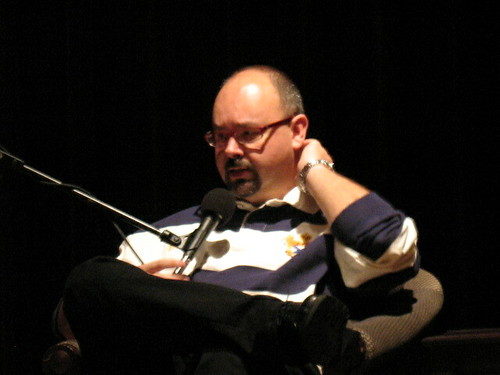
Carlos Ruiz Zafón at International House
Zafón was recently interviewed by 57th Street Books' Tom Flynn, at the University of Chicago's International House.
Comparing The Angel's Game to The Shadow of the Wind, he describe the former as darker, and more complicated, than the latter. They are both parts of what he expects to be a four book "series". "Series" in quotes, because the order of reading is not critical. The experience of the reader will differ depending upon that order, as you combine pieces of a puzzle.
He wanted to use Barcelona as a character. In The Shadow of the Wind, the city was a stagnant, post-Civil War world, while in The Angel's Game, it is a city in turmoil, exploding with the violence of the Civil War to come. The book reflects the darker nature of the times.
In future books, says Zafón, we will learn more about the Cemetery of Lost Books. The idea for that place came to him originally in Los Angeles, a city that made him think about the destruction of memory. Driving around the county, and finding gargantuan second-hand bookstores like Long Beach's "Acres of Books", a store with corridors of books, housing a demonic cat. With the loss of such stores, we lose not just books, but ideas and a sense of identity.
On literature: many people who become writers experience literature as an ungrateful lover. LIterature tries to figure out the basic elements of life. When it works, it helps us better understand ourselves and the world.
What books made an impression on him? The world of books itself, of language, words, style. As a child he read everything. He has never trusted the labels we put on books. In his work, he is trying to communicate respect for books.
On the translations of his books: the translator, Lucia Graves, is the daughter of Robert Graves. She read his books and came to him with the idea of translating them into English, although she had never done so professionally. Reading the first pages she translated, he felt she captured the essence of the his book. They worked together - she would translate, he would review it and provide ideas. (He himself is quite fluent in English.) Says Zafón, you only notice a translation when it doesn't work.

50.
The City of Dreaming Books, by Walter Moers
At Lindworm Castle in the country of Zamoria, every young dinosaur has an authorial godfather who is responsible for his literary education and training. When young Optimus Yarnspinner's godfather, Dancelot Wordwright, dies, he leaves his charge a manuscript of such surpassing genius, a piece of writing so perfectly right, that Optimus decides that he must find the author and learn from him.
And so he leaves home and heads for the city of Bookholm, a town that "reeks of old books", where the inhabitants walk with "stacks of books under their arms - indeed, many tow whole handcarts laden with reading matter". But as he begins his search for the mysterious author amid the city's five thousand antiquarian bookstores, it becomes apparent that all is not as it seems. Hidden beneath the city are labyrinthine tunnels where Bookhunters seek rare and precious tomes, and where danger lurks. Optimus finds himself trapped in this nether world, and must find his way back to the light. It is his adventures there that form the core of this delightfully exciting book, as he fends off living books (animatomes), spends time among the Booklings (each of whom has memorized the entire output of such literary geniuses as Aleisha Wimpersleake and Wamilli Swordthrow), and learns the secret of the Shadow King.
An utterly charming and amusing book, filled with literary puns. Many booklovers will appreciate the scene where, hypnotized by an odd form of music, the populace madly invades the bookstores, "sweeping books off the shelves regardless of title or author, price or condition . . . I had been smitten with an insatiable hunger for books and only one thing could cure it: buy, buy, buy!" Sounds like me at the Newberry Library Book Fair.


 Ben Hecht, screenwriter, journalist, author of "obscene" novels - who knew he wrote children's books as well? I didn't, until I found this little volume at a used book sale. It's a charming book, about Catarinka, a black cat who came out of the moon, and who has a Great Secret, one which she is afraid other cats would find out. Her friends, the mice Itzel and Bitzel, try to discover it, but she resists. Then comes Mickey Lickey, the Worst Cat in the World, who will turn her into hash if she doesn't tell him! Catarinka, however, outsmarts him, by, well, that would be telling!