Monday, June 22, 2009

41. Death Vows: a Donald Strachey mystery, by Richard Stevenson

When Jim Sturdivant calls private detective Donald Strachey to investigate Barry Fields, the young man his friend, Bill Moore, is about to marry, Strachey naturally expects to find a gold-digger. He does find that Fields, and his friend Bud Radziwill, had popped up seemingly out of nowhere several years earlier. But he also learns that, far from being friends of Moore's, Sturdivant and his partner have been engaged in some underhanded loan dealings with him and other members of the town's gay community.

When Sturdivant is found shot to death following a very public confrontation with Fields, the latter is naturally the prime suspect. His fiancé hires Strachey to clear his name, and find the real killer. In the course of so doing, Strachey learns that just about everyone has a secret, some relevant, some not. The whole ends with a confrontation between a Fred Phelps-like religous sect and a bunch of Mafiosi!

A light, quick, enjoyable read.

Sunday, June 21, 2009

Shoe Fleur


40. Shoe Fleur: a Footwear Fantasy, by Michel Tcherevkoff

Photographer Michel Tcherevkoff noticed that a leaf, the photograph of which he had just taken, looked like a shoe. He manipulated the image and came up with his first "shoe fleur". Inspired, he made more of these fantastic images, now not only of shoes, but of handbags.

These images have been gathered into a book, a book which is itself a work of art. Heavy cardboad covers with the image of a shoe on the front and a handbag on the back are attached to a cloth-covered spine which carries the title and author information. The endsheets are a pale green, with a faint leaf design. The title page is faux vellum, with the script "shoe fleur", overlaying an image of that first shoe, called "La Première". The book is enclosed in a pink plastic slipcase with a ruffled edge that meets the image of leaves on the cover and a circular opening that reveals a variegated tulip that is part of the cover shoe.

Interestingly, although these shoes are fantasies, many of the designs, if translated into less delicate, less ephemeral, materials, would be quite wearable. I would certainly be happy to own any of these items!

The photos and text are enhanced by a preface written by Ferruccio Ferragamo and an introduction by Diane von Furstenberg.

And you've got to love the punny title!

More images can be seen at Tcherevkoff's website.

Thursday, June 18, 2009

Stone's Fall


39. Stone's Fall, by Iain Pears

Do not be afraid of this book's 800+ pages! Because it is a page-turner.

It begins in a cemetery, at the funeral of one Mme. Robillard. Matthew Braddock, who knew her under another name, in another time, in another place, is approached by a representative of her lawyers' who informs him that the firm is holding a parcel intended to be given him only upon Mme. Robillard's death. But it will be another 300 or so pages before we learn the contents of that parcel. First, Braddock must tell us the story of how he met Mme. Robillard, or Elizabeth, Lady Ravenscliff, as she then was.

That story begins in London, in 1909, when Braddock she hires Braddock to investigate the mysterious death of her husband, financier and arms dealer John Stone, Lord Ravenscliff. As he delves into the case, he finds complex layers of intrigue and, not incidentally, falls in love with the widow Ravenscliff. Naturally enough, neither she nor Ravenscliff, nor any of their colleagues, is what they at first appeared to be. So dramatic and compelling and complete a story is this narrative that, at the end, I found that I had forgotten that parcel and was startled to find that I was only one-third through the book.

The second part moves back in time, beginning in Paris in 1890, and is the story of one Henry Cort, who had become known to Braddock during his investigations. Another mysterious figure, to say Cort was an intelligence operative for the British government is to understate the case. His parcel contains his narrative of his own life, and how he came to his position, and how he knew Lady Ravenscliff, before she was a lady at all.

It also contains certain documents of John Stone's, documents that had gone missing at his death. These form the third part of Pears' novel, and go back even further in time, to Venice, 1867, where Stone's enterprise begins. And it is here that we learn the real history of Elizabeth, and the reason and manner of Stone's death. It will, I think, be a surprise.

Those familiar with Pears' An Instance of the Fingerpost will, however, not be surprised at his ability to take multiple strands of narrative and weave them into a complicated, yet understandable, whole. Like the best Victorian triple-deckers, Stone's Fall is full of surprises, twists and turns, but it hangs together logically. Even more than this, Pears creates characters who engage our sympathy, even if their actions do not. Like real people, their psychology is not simple, and their motives are mixed. Some do good for bad reasons, and some act badly for good reasons. Some act for no reason, but emotionally. Just like you and me.

Saturday, June 13, 2009

Tutto Dante: an evening in the Second Circle of Hell


(or, from the ridiculous to the sublime.)

The Italian actor, writer, director, etc. is also a Dante scholar, and he has been touring in a program called Tutto Dante, which ranges from humor to intellectual discourse to dramatic reading.

Benigni bounds onto the stage, in a manner that will be familiar to anyone who anyone who saw his reaction at the 1998 Oscar ceremony when Life is Beautiful won Best Foreign Film. His show begins with humor, with particularly pointed jabs at Silvio Berlusconi that were greeted with loud laughter and cheers by the largely Italian audience. He also took a swipe at ex-Governor Blagojevich. I don't know if it was a coincidence that there were two empty seats front row center, but he said, "Blagojevich booked a seat, and then sold it." He also expressed great admiration for Chicago, especially its architecture. He does not, however, understand why the cabs and hotels have the air conditioning turned on in this un-spring like weather (neither do I!).

After a while, Benigni becomes what you would like your college lecturer on Dante to be. (I have to say, though, that my high school English teacher effortlessly taught me to love his work.) His passion for the Divine Comedy is palpable, and his discussion of it deep and broad, if not always accurate. He begins by placing the text in its time and place, talking about Florentine history and politics, literature and philosophy.

quel giorno più non vi leggemmo avante
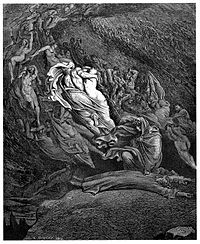
His focus is Canto V, the second circle of Hell, in which Dante meets and speaks with Francesca da Rimini, who tells him the story of her passion for her brother-in-law, Paolo Malatesta (the scene is depicted below in the Doré illustration):


Each tercet, in the Robert and Jean Hollander translation, is displayed, one at a time, on a screen as he delves into its meaning, its metaphors, what it shows us about the progress of literature. And here is where he, in his passion for this poem, goes, I think, a bit astray. He credits Dante with being the first to use "I" in poetry, to address and write about ordinary people. I immediately thought, "What about Sappho?" And she's not the only one. Nor was the concept of "pity" a new one; Aristotle spoke of it in his description of tragedy centuries earlier. Nevertheless, the discourse was instructive and compelling.

Then, Benigni set aside the lectern. The lighting changed. Facing the audience full-on, he took a breath, and, changing from English to Italian, he began:

Così descesi del cerchio primaio
giù nel secondo, che men luogo cinghia,
e tanto più dolor, che punge a guaio.

"From the first circle thus I came descending
To the second, which, in narrower compass turning,
Holds greater woe, with outcry loud and rending."
(Canto V, ll.1-3, Dorothy L. Sayers' translation)

He recited the entirety of the canto from memory. (I understand that he has the whole Commedia by heart!) The recitation was deeply moving, even to those of us whose knowledge of Italian (particularly medieval Italian) is not great. By the time he reached the end, e caddi come corpo morto cade ("and, as a dead man falling, down I fell"), we were on the edge of our seats.

Share the experience:


(Photo of publicity poster by: jkannenberg, Creative Commons by-nc-nd 2.0)

Sunday, June 7, 2009

Printers Row Lit Fest (formerly the Printers Row Book Fair)

Keeping dry

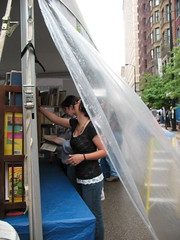
Neither rain nor snow nor gloom of night shall keep the book hunters from their appointed rounds. Well, okay, there's no snow in Chicago in June, nor is the Fest held at night, but this morning's sprinkles just brought out the plastic to cover books and browsers. The weather forecast said the storms would come in the afternoon (in the event, they didn't), so I went down in the morning, not deterred by the aforesaid sprinkles. In fact, the cool and overcast weather was ideal for walking and browsing, particularly as the day wore on and my bag of books got heavier and heavier. (Fortunately, Half Price Books was giving away nice big bags.)

Since the Chicago Tribune took over from the South Loop Planning Board several years ago, the event has seen a bit of a change in focus, so that author readings have increased tremendously, with events at the Harold Washington Library Center and the University Center as well as at the Fair itself, and there are more non-book exhibitors (t-shirt manufacturer? yarn store?). But it's still a ton of used bookstores, along with small presses and university presses, and a lot of self-published authors.

I made a fair haul:
Chicago Churches, by Elizabeth Johnson (which I reviewed here)
Asia in the Eyes of Europe: Sixteenth through Eighteenth Centuries, a catalogue from an exhibition at the University of Chicago Library
Shoe Fleur: a Footwear Fantasy, by Michel Tcherevkov, photographs of shoes made of flowers (!)
Permissions: a Survival Guide: blunt talk about art as intellectual property, by Susan Bielstein
The Pleasures of Japanese Literature, by Donald Keene
The Heather Blazing, a novel by Colm Tóibín, one of my favorite authors
Napoli in Cucina, by Fabrizia Gerli
Bolzano in bocca, by Eva Kurt

The last two are cookbooks in Italian, of which one seller had a huge number! Kurt's book is actually a triple-language book: German, Italian and English. It's a very nicely designed book, with cardboard covers and old-style illustrations, printed on a heavy paper. The recipes are in German on the verso, in a font designed to resemble handwriting, and then in Italian and English on the recto. There's a glossary in the back, with German terms translated into Italian. I may try some of the recipes, but not the Beef Brain Croutons.

I was also very tempted by an edition of Dante's Divina Commedia, in Italian, with the Doré illustrations, but at $150 (even though the guy would have come down) it was way out of my price range.

I stopped by the Charles H. Kerr booth:
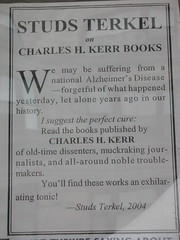
Studs on Charles Kerr
hoping to speak to Penelope Rosemont and give her my condolences on Franklin's death. I had just missed her; however, I left a note and will go to the memorial service at the Newberry in July.

I did see Michelle Duster, whose book, Ida in her own words: the timeless writings of Ida B. Wells from 1893, I had bought at the Association of Writers and Writing Programs Conference Book Fair. We had a nice chat and said rude things about the University of Chicago and its relations with the community.

It wasn't all books, however. As I strolled down the street, I was accosted by a woman, an animal shelter volunteer, who asked me if I'd like a cat or kitten! I demurred, telling her that I already had two cats. She agreed that I had done my part, but noted that there were cats and dogs up for adoption who could be visited in the grooming salon right behind us. So, I visited. Look! A two-headed cat!
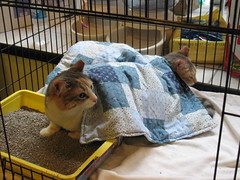
Please adopt me and my sister!
(Oh, not really. Just two kitty siblings sharing a blanket.)

All in all, it was a lovely day, and now I have a bunch more books to read.

Blue 2


38. Blue 2: A Pop-up Book for Children of All Ages, by David A. Carter

A pop-up book and an alphabet book, it's two of my favorite things! There's a blue "2" somewhere in each pop-up, and they're not all easy to find. Look inside the pop-up, turn it upside down. Where is it? I had fun with this, though I wonder if some children might get a bit frustrated at the difficulty of finding some of the 2s, those "terrible twos"! (Sorry, couldn't resist.)

Chicago architectural photographs - churches and the River

36. Chicago Churches: A Photographic Essay, by Elizabeth Johnson

Take any expressway into the city, and you will be struck by the number of spires and steeples that you see. Chicago is a city of neighborhoods, a place where many people, when asked where in the city they live, name their parish. Chicago is a city of immigrants, and they brought their religions with them and built buildings in which to worship. As the city's demographics changed, a church named for a German saint fills with Mexican worshipers, a Greek Orthodox church becomes a mosque. And in the city that invented the skyscraper, we have a church housed on the top floor of an office building.

Elizabeth Johnson traveled the city (and some of the suburbs), photographing houses of worship. (The title Chicago Churches is really a misnomer, as she includes synagogues and mosques.) They range from the ghetto storefront churches to Frank Lloyd Wright's architectural masterpiece, Unity Temple, from the Gothic splendor of Rockefeller Memorial Chapel to the sterility of the O'Hare Airport Chapel.

The photographs have an old-fashioned sepia tinge to them, and the buildings appear in a variety of moods. Johnson often takes a shot angling upwards, as though reaching for the heavens, and she likes to juxtapose a traditional church building with a modern neighbor, as with the cover shot of a steeple seen next to the antennae of the John Hancock. Interspersed throughout the book are quotations from the world's major religions.

A beautifully designed book, this should find a home on the shelves of anyone who loves Chicago, architecture, photography, or (like me) all three!

37. Chicago from the River, by Joan V. Lindsay

If you come to Chicago any time from May to November, I will advise you, nay, order you, to take the Chicago Architecture Foundation's Architecture River Cruise. I can't think of a better way to see some of Chicago's most magnificent buildings, and also to learn and understand the importance of the river to Chicago's history and growth. It's the best damn tour there is.

One of the reasons it's so good is the docents. The CAF training is incredibly deep, and these people know whereof they speak (even if I don't always agree with them - we're not all fans of Helmut Jahn!). Joan V. Lindsay went through that docent training and acted as a guide on river tours, so it's not to be wondered that she has penned a lovely paean to the river and to Chicago architecture. It's a slim volume, but filled with beautiful photographs and plenty of information about the buildings. The captions don't simply give the name of the architect and date of the building, but describe the style and place the building in the context of Chicago's architectural history. She's also thrown in a couple of old photographs of the city so we can see how it's changed. What's a bascule bridge? Why does the River run backwards? Lindsay knows, and tells.