Saturday, April 11, 2009

Morgan Art of Papermaking Conservatory and Educational Foundation

     When I was visiting my sister in Cleveland, we went to a triple opening at the Morgan Art of Papermaking Conservatory and Educational Foundation (whew! there's a mouthful!).  The shows were the Art Books Cleveland Salon Show, Monumental Ideas in Miniature Books and Trifold - Book, Print, Pulp.  As with all such shows, there were good, bad and indifferent works.    And the design of the miniature book show left a bit to be desired.  Some of the pieces were crammed together, so that one couldn't get a good look at them, and one tunnel book was so far below anyone's eye level that you had to bend waaaaay down to see it.

Below are some of my favorites:
 Japanese Book Bottom Cut I, by Gene Epstein

 
Movement VI, by Hyoyoung Shin

 
Fish Book, by Amy Fishbach (okay, I love it in part because of the pun)!

  I think it's a wonderful thing that Cleveland has a papermaking/book arts place.  But they have some issues.  As you can see from the image at the top, this place is huge!   Too huge, in fact.  I'm told they shut down in the winter because they can't heat it properly.  That's a real shame.

Wednesday, April 8, 2009

Eat your books!

Every April 1 or thereabouts, there are Edible Book Teas around the country (and the world). I usually go to one held at Columbia College, but this year I was out of town visiting my sister in Cleveland. But never fear! Loganberry Books and Strong Bindery (located in the bookstore) sponsored an event on Saturday, April 4. So we went.

It was an interesting contrast to the Columbia event. There, the entries tend to focus on the structure of the book or punning on the titles. At Loganberry, most of them were very straight-forward interpretations of a book, although with some punning, too. This wasn't a bad thing, just different.

My personal favorite was Origami 101, with actual folded fondant critters!


Also, please note that, on this occasion, Moby Dick lost:

Tuesday, April 7, 2009

Sima's Undergarments for Women


24. Sima's Undergarments for Women, by Ilana Stanger-Ross

In the basement of her Brooklyn home, Sima Goldner has for three decades run a lingerie shop. She has, in that time, struggled with infertility and the secret of her youth that caused it, a secret that she kept from her husband and which has, as a result, made her marriage as barren as her womb. She is something of an outsider, too, in the neighborhood, being a not-very-observant Jew in the Orthodox community of Boro Park.

Then a young Israeli woman enters her shop. Sima is strangely drawn to her, and, when asked, gives her a job. Sima's attraction to Timna is at first described in terms that can only be called erotic, but it soon becomes clear that, in her loneliness, she is treating the girl like the daughter she never had. She so desperately wants to be important to Timna, to be a part of her life outside the shop, that she actually begins to follow her, and to interfere in her personal life.

Stanger-Ross' narrative alternates between the present and Sima's past, with her history explaining her current life. But she gives us very little of Timna's life, past or present, and this results in an imbalance that damages the story. All the weight is on Sima, and Timna seems a stick figure. We get no real sense of what sort of a person Timna is, other than as someone to whom Sima reacts, and, as a result, we don't understand why Sima reacts to her in the manner that she does.

Stanger-Ross' writing does, however, show promise, particularly in those sections of the book delineating Sima's relationship with her husband, Lev, and the vignettes of her lingerie shop's customers, and I would certainly consider picking up future work of hers.

Monday, April 6, 2009

The Suspicions of Mr. Whicher

23. The Suspicions of Mr. Whicher: A Shocking Murder and the Undoing of a Great Victorian Detective, by Kate Summerscale 

  If you have read Wilkie Collins' The Moonstone, you have encountered, in the person of Sergeant Cuff, Detective-Inspector Jonathan Whicher of Scotland Yard. In other fiction of the period, you may well have found echoes of the murder case about which Ms. Summerscale writes. In the early hours of June 29, 1860, in the country house of Road Hill, near Trowbridge, England, a three-year-old boy named Saville Kent was spirited from his crib and murdered, his body found the next day at the bottom of the privy. When, after two weeks, the local police were, as Sherlock Holmes would have said, "baffled", they called in Scotland Yard, which sent DI Whicher. All signs suggested that the murderer must have been someone resident in the house. Then, on July 20, Whicher convinced the local magistrates to issue a warrant for the arrest of Constance Kent, the child's half-sister. But after a hearing to determine whether there was sufficient evidence to charge her, Constance was released. On October 1, at the behest of a solicitor who headed a commission investigating the murder, the nursemaid, Elizabeth Gough, was arrested, but the upshot was the same. 

The public was fascinated by the case, and everyone fancied himself Whicher's rival in detection. Fingers pointed at the nursemaid, at the child's half-siblings, even at the child's father. Theories suggested adultery and madness. Newspapers alternately and variously supported Inspector Whicher's actions and attacked them. And it would not be until years later, with a confession, that the murder would be solved (though, even then, questions arose as to the reliability or complete truthfulness of that confession). 

Why did this case arouse so much interest, so much public passion and debate and involvement? There were many reasons. The crime itself struck at the most private, protected place of an Englishman: his home. The investigation necessitated prying into a family's intimate secrets, and, worse, that prying was done into an upper-middle-class family by a man of the working class. Detectives were something new in England, and the English weren't quite sure they liked the idea. Summerscale's great strength here is the way she interweaves the story of the murder with threads about English society in 1860. 

It's a fascinating story in itself, but is made far more nuanced by the way in which Summerscale relates it to the developments in England at large. I will say that I have seen at least one review of this book that complains that has "too much detail", and doesn't read sufficiently like a story. Hello? It's non-fiction, people! Frankly, I was rather impressed at how Summerscale was able to incorporate what was, in effect, a study of societal mores into the discussion of the murder case, and still make the book flow like a good novel without jettisoning scholarship. 

(A note on notes: this book was extensively researched and, while endnotes are given for each chapter, Summerscale has also indicated "main sources" for groups of chapters. My one criticism of these notes is that, rather than having numbered endnotes, there are simply page references with the beginning of a sentence quoted. What's wrong with a superscript number and a corresponding endnote ((though a footnote would be preferable))? I do not understand why editors expect readers to be constantly flipping to the back of a book to see if there's a note or notes. I don't know if this is generally a choice of the author or of the editors, but I wish it would stop.)

Thursday, April 2, 2009

Passing Strange

22. Passing Strange: A Gilded Age Tale of Love and Deception Across the Color Line, by Martha A. Sandweiss

When Clarence King died in Phoenix, Arizona, in 1901, he was eulogized by friends like John Hay, private secretary to Abraham Lincoln and Secretary of State under McKinley and Theodore Roosevelt, and historian and memoirist Henry Adams. He was remembered as the first director of the United States Geological Survey, the man who exposed a diamond hoax that threatened the economy of the United States, a devoted son and confirmed bachelor.

He was all those things, except the last. The man who, in 1880, said that he had lost the only woman he had ever wanted to marry through too much attention to duty, in 1888 married a woman so far outside his social circle and standing that he did so under a false name, a false occupation, a false identity and a false race. For Clarence King, son of a prosperous China trader, interlocutor of Ruskin and Turner, guest at the White House, had fallen in love with Ada Copeland, an African-American woman born into slavery. He courted her under the name "James Todd", and told her he was a Pullman porter, a job which must mean that he, too, was African-American.

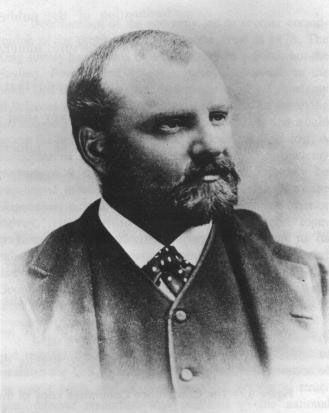
How this blond, blue-eyed man passed as black is more than a story of love and deception. It is the story of how this nation has interpreted race and how social and cultural assumptions translate into racial "certainties". It was interesting to compare how King used those assumptions to pass as black with way in which Belle da Costa Green used them to live as white (see An Illuminated Life). Although in some parts of the world distinctions were and are drawn between "white", "black" and mixed race ("colored", "mulatto" "mestizo"), in the world of Clarence King/James Todd any black ancestor made you black, no matter how you looked. At the same time, people took their cues about someone's race from their surroundings. So King, looking like this:


could be perceived as "black" simply because he was met in an African-American neighborhood, visited an African-American church, and claimed to be a Pullman porter, a job for which only African-Americans were hired. (Curiously, though, he was in fact a bit too light-skinned for that to be entirely credible, as light-skinned blacks were more likely to be dining-car attendants.) A census-taker would look at the "white"-appearing children of Ada and Clarence (James) and mark then as "black" upon seeing their mother. (In fact, their two daughters would eventually marry white men and list their race as "white" on the marriage license applications.)

When King was dying in Arizona, away from his wife and family in New York, he finally revealed his secret to her, via letter, and to certain of his friends. Because he had kept Ada in the dark as to who he was and what his real life was, because, in order to keep his secret, he had left no documentation of their relationship other than his letters to her (obviously, though, not under his real name), she had no idea of his true financial situation either. And he had, foolishly, made no provision for them in his will, which left everything to his mother. Based on things that he had told her, Ada believed that he had left money in trust for her and the children, and his friends arranged to have money sent to her each month, which she believed came from that trust. It was not until many years later that Ada sued in court to obtain the funds she believed were rightfully hers. The forces of privilege were marshalled against her.


Ada King died in 1964 at the age of 103. Did she hear Martin Luther King, Jr. speak of his dream that "the sons of former slaves and the sons of former slaveowners will be able to sit down together at the table of brotherhood" and think of her own life? Did she hear "I have a dream that my four little children will one day live in a nation where they will not be judged by the color of their skin but by the content of their character" and think of her husband and children, whose races were judged, not by the color of their skin, but by the company they kept?

Sandweiss has written an engaging account of the lives of King and Copeland, separately and together. She has illuminated their relationship, and Ada's later legal efforts, through the prism of American social, class and racial mores. Her work is thoroughly researched, through interviews and consultation with primary sources, and any speculation (for instance, as to where and how the two may have met) is clearly labeled as such and is backed by credible argument.

Passing Strange is both a love story and a story of the racial and social divides of 19th-century America, and is successful at telling both.

Saturday, March 28, 2009

Katrina tales


21. Do You Know What It Means To Miss New Orleans? A collection of stories & essays set in the Big Easy

Do You Know What It Means to Miss New Orleans?Is that not a great title page? The whole book is like that, marvelously designed. The cover image is Cassiopeia A: The colourful aftermath of a violent, stellar death. (This is the second edition, and I was torn, I tell you, torn! Do I buy the 1st because it's a first, or the second for the cover? You decide.)

You do have to read every word of this book. And I do mean every word. A tease from the copyright page: "All rights reserved. . . . Exceptions are made for book reviewers. By the way, there are no jokes here so you can stop reading if you are looking for them."

"This book was written and designed during three months in the fall of 2005." In the aftermath of Hurricane Katrina, Chin Music Press put together this slender, beautifully made anthology that will make you laugh and cry and rage. And cook. There are recipes, too. Interspersed throughout are engravings from the 1885 volume, Historical Sketch Book and Guide to New Orleans.

There are two ways to read this book. The first gathers the contributions into three sections: "The Dirge", "The Return" and "Lagniappe". But if it is too hard for you to read all those stories of ruin and devastation, one right after another, before reaching hope, there is an "Alternative Reading Order. Inspired by the many different versions of the song "Do You Know What It Means to Miss New Orleans?" I read it the second way and still shed more than one tear along the way. All over again, I saw the images of things that should never happen in this country, heard the stories of grace and generosity, stupidity and blindness.

Thank you to Toni McGee Causey for her eloquent essay, "Where Grace Lives". Thank you to Jason Berry, for his tale of evacuation, "The Holy City of New Orleans". Thank you to Colleen Mondor, who has never been to New Orleans for "Listen to the Second Line", about the music that I, too, love and cherish. Thank you to Ray Shea for the laughter and memories he shares in "I was a Teenage Float Grunt". Thank you to Rex (oh, appropriate first name!) Noone for his story of the power of celebration, "Professor Stevens Goes to Mardi Gras". Thank you to everyone who contributed to this book. But most of all, thank you to Chin Music Press, who gave it to us.

There are more voices here.

Arguing with the Storm

20. Arguing with the Storm: Stories by Yiddish Women Writers, edited by Rhea Tregebov

In 2000, a group of senior Jewish women in Winnipeg, intrigued by the large Yiddish collection at the Winnipeg Public Library, decided to form a reading circle for discussion of these works. Concerned that these works would be lost, they began to translate the stories and memoirs, and this book is the result.

Although the women represented here are all Eastern European, they led varied lives, some active in the worlds of literature and journalism, others not so much. Some emigrated, to the United States, to Canada, to Palestine (as it was then); others were lost in the Holocaust. All had something to say.

The works of the nine writers represented here range geographically from the shtetl to Miami Beach, in time from the 1905 Revolution to the present. The characters are young women and old, country and city dwellers, immigrants, Holocaust survivors, and their children and grandchildren. Some are funny, some somber, some in between.

If your idea of the shtetl was formed by "Fiddler on the Roof", read Rochel Broches devastating account of the short life of mamzers in "Little Abrahams" or Sarah Hamer-Jacklyn's "No More Rabbi!" Hamer-Jacklyn and Frume Halpern write movingly of the plight of older women, the search for stability and love. Bryna Bercovitch and Paula Frankel-Zaltzman are represented by their memoirs, the one of life in the Ukraine, the other of the Dvinsk ghetto.

We owe the Winnipeg Women's Yiddish Reading Circle a debt of gratitude for rescuing these stories from the library's dusty shelves, and making them available to a new audience.